

Asian Financial Forum 2026
IEMS Experts Examine the Role of Agentic AI in Fighting Financial Crime at Asian Financial Forum 2026
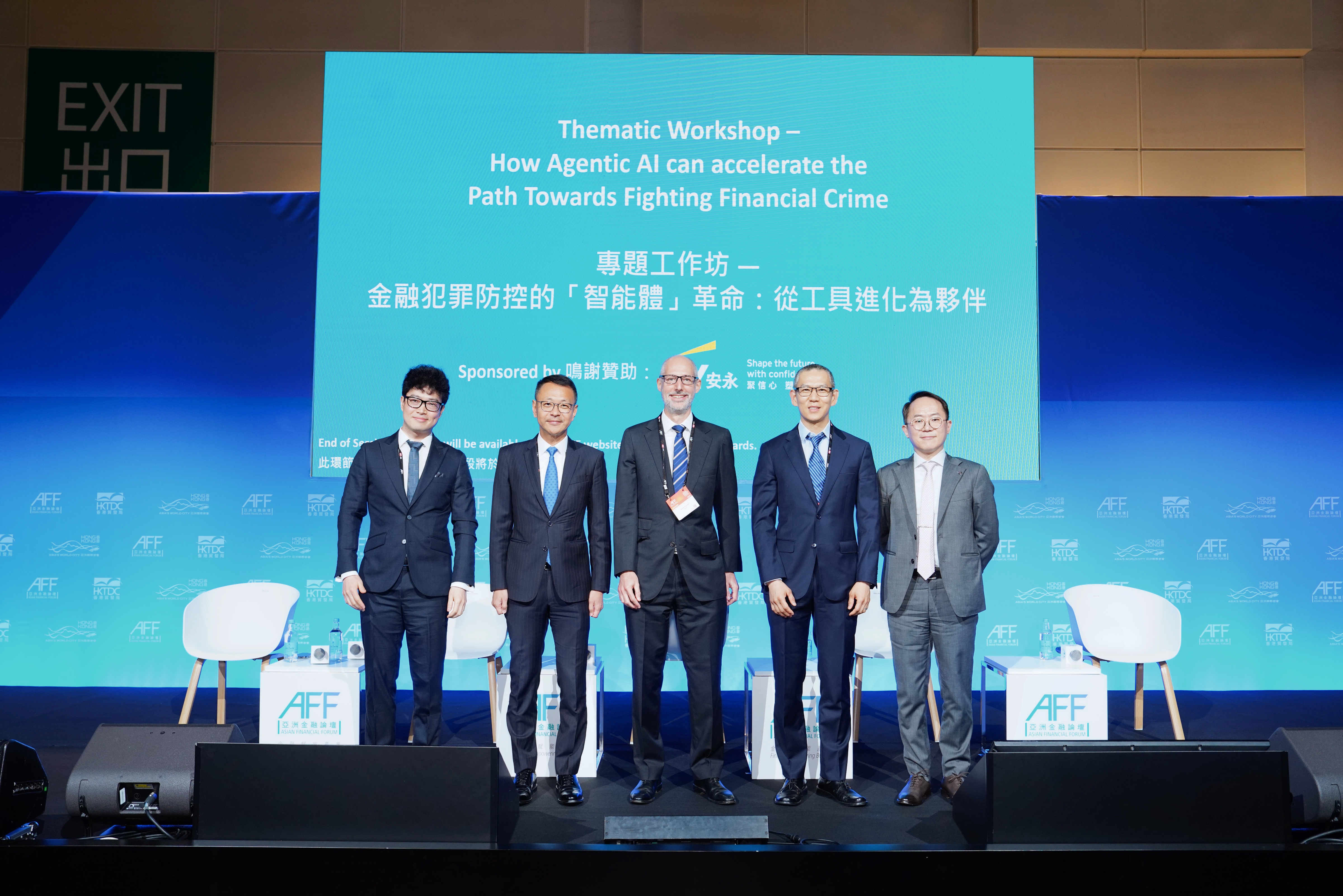
At the Asian Financial Forum 2026, experts from academia, regulatory bodies, and the banking sector gathered to discuss how emerging technologies are transforming financial crime prevention. As one of the panel discussions held during the Forum, the session titled “How Agentic AI Can Accelerate the Path Towards Fighting Financial Crime” explored the potential of agentic artificial intelligence to enhance the effectiveness and efficiency of anti-financial crime efforts amid an increasingly complex risk environment.
The panel was moderated by Dr. Justin Cai, Partner, FinTech and Innovation, Greater China, Ernst & Young Advisory Services Limited, and featured a diverse group of speakers representing key stakeholders across the financial ecosystem.
During the discussion, Professor Allen Huang, IEMS Faculty Associate, Head and Professor of the Department of Accounting and Associate Director of the Center for Business and Social Analytics at The Hong Kong University of Science and Technology, shared his perspectives on the evolution of artificial intelligence from traditional machine learning models to generative and agentic AI systems.
Professor Huang highlighted that conventional transaction monitoring systems are largely rule-based, often resulting in high volumes of false positives and limited ability to capture complex relationships across data. He explained that agentic AI enables a shift towards a principle-based approach, allowing systems to reason more holistically about whether a transaction is genuinely suspicious. By integrating multi-modal data, including text, images, and transactional information, and allowing multiple AI agents to interact and collaborate, agentic AI can support more adaptive and context-aware financial crime detection.
He also emphasized that while agentic AI holds significant promise, challenges related to explainability, performance evaluation, and trust must be carefully managed. Sustained testing, monitoring, and human oversight remain critical, particularly in high-impact areas such as compliance and enforcement.
Joining Professor Huang in the discussion were Raymond Chan, Executive Director (Enforcement and AML) of the Hong Kong Monetary Authority; Olivier Franses, Regional Head of Financial Crime Detection, Asia, The Hongkong and Shanghai Banking Corporation Limited; and Chris Yip, General Manager of the Financial Crime Compliance Department, Bank of China (Hong Kong). Together, the panelists shared perspectives on the opportunities and challenges of deploying advanced AI technologies and discussed how collaboration across disciplines can support more resilient, responsible innovation in financial crime prevention.
The panel underscored the importance of continued dialogue between academia, regulators, and industry practitioners as financial institutions explore how agentic AI can be responsibly integrated into existing frameworks to strengthen defenses against evolving financial crime threats.
Photo Captions:
|
|
|
Professor Allen Huang shared his perspectives on the evolution of artificial intelligence from traditional machine learning models to generative and agentic AI systems. |
|
|
|
The panel was moderated by Dr. Justin Cai, Partner, FinTech and Innovation, Greater China, Ernst & Young Advisory Services Limited, and featured a diverse group of speakers representing key stakeholders across the financial ecosystem. |

Get updates from HKUST IEMS